


L-ergothioneine is produced industrially through three main routes: natural extraction, chemical (including chemical-enzymatic) synthesis, and whole-cell fermentation. Which route a maker uses directly shapes how pure and how stable the product you buy will be, and ultimately how it performs.
GeneIII uses the whole-cell fermentation route, letting the molecule form naturally inside living cells and reducing the introduction of external chemicals from the source.
This article explains the differences between these three routes, to help you judge from the production source whether an L-ergothioneine is pure and trustworthy.

The Three Production Routes for L-Ergothioneine
There are three industrial routes for L-ergothioneine, and they differ in where the molecule comes from and how it is assembled.
Natural extraction pulls L-ergothioneine from raw materials such as mushroom fruiting bodies and plant seeds. It is limited by feedstock supply, tends to yield lower purity, and carries higher costs for controlling pesticide residues and heavy metals, which makes large-scale, consistent supply difficult.
Chemical synthesis and chemical-enzymatic routes start from histidine and build an intermediate through several chemical steps before completing the synthesis. These routes use chemical reagents at the intermediate stage.
According to published patent descriptions, some chemical-enzymatic routes use methyl iodide when preparing the histidine betaine intermediate.
Whole-cell fermentation is the leading method today, widely regarded as the green, sustainable direction. Within it, fermentation using engineered strains is considered the most promising, because it does not rely on a chemically synthesized intermediate, with the molecule produced naturally inside living cells.
Expert tip: How pure an L-ergothioneine can be, and how consistent it stays from batch to batch, is largely decided the moment a production route is chosen. For consumers, the closer a route stays to nature and the fewer chemical steps it introduces, the purer the final product and the fewer its impurities.
The Whole-Cell Fermentation Process
GeneIII's L-ergothioneine is made through this engineered-strain fermentation route, letting the molecule form naturally inside living cells.
Here is one way to picture it. The cell itself acts as a complete "green factory." We introduce the genes for L-ergothioneine synthesis into a chassis cell such as E. coli, and the bacteria produce L-ergothioneine inside their own cells, following a natural metabolic pathway. The molecule is then purified from the fermentation broth, so the entire synthesis happens inside a living, self-regulating system.
Two features of this route are worth explaining. First, it does not depend on a chemically synthesized intermediate, since the molecule is produced by the cell's own metabolism, with no need for chemical reagents to build an intermediate first. Second, it draws on the cell's own metabolic supply, improving synthesis efficiency by strengthening natural metabolic cycles inside the cell, such as the SAM (S-adenosylmethionine) cycle, rather than relying on external chemical reactions.
Expert tip: Chemical synthesis routes use chemical reagents and have to remove any residue afterward. Whole-cell fermentation never introduces those reagents in the first place, and the molecule forms naturally inside the cell. For consumers, this means taking an L-ergothioneine that is closer to natural, with no concern about residual chemical reagents.
From Process to Product: Purity and Consistency
A good production route is only the first step. Final quality still depends on downstream purification and quality control. In the L-ergothioneine field, purity is the key determinant of a finished product's safety and functional stability, and a core measure of a company's manufacturing capability.
This is reflected in the Global Ergothioneine Industry Current Landscape and Development Trends White Paper, jointly released by Frost & Sullivan and GeneIII. The report notes that leading manufacturers, using cGMP pharmaceutical-grade platforms, have benchmarked raw-material quality against international standards such as SGS, CP, USP, EP, and JP, reaching a pharmaceutical-grade purity level of 99.99%.
GeneIII's L-ergothioneine reaches 99.99% purity, confirmed by third-party testing from SGS (report No. ASH25-0074172-04), and is produced under cGMP pharmaceutical-grade manufacturing, ensuring batch-to-batch consistency from raw material to finished product.
In practice, the ingredient in each capsule is more uniform and more predictable. You can read more about the science behind GeneIII's L-ergothioneine.
Expert tip: Higher purity means more active ingredient and fewer impurities, while cGMP pharmaceutical-grade manufacturing keeps quality consistent across batches. For consumers, this means every purchase delivers the same purity and the same quality.
Process and Safety: From Source to Notification
A production route ultimately comes down to one question: does it hold up under evaluation?
GeneIII's whole-cell fermentation process has completed an FDA GRAS notification. In January 2026, GeneIII L-Ergothioneine received an FDA "No Questions" Letter for its GRAS notification (GRN 001270). Within that notification, the highest notified use level under GRN 001270 is 150 mg per 100 g for protein and nutritional powders, and notified use levels vary by food category.
For consumers, this means the process GeneIII has chosen, and the serving range that goes with it, are evaluated and verifiable.
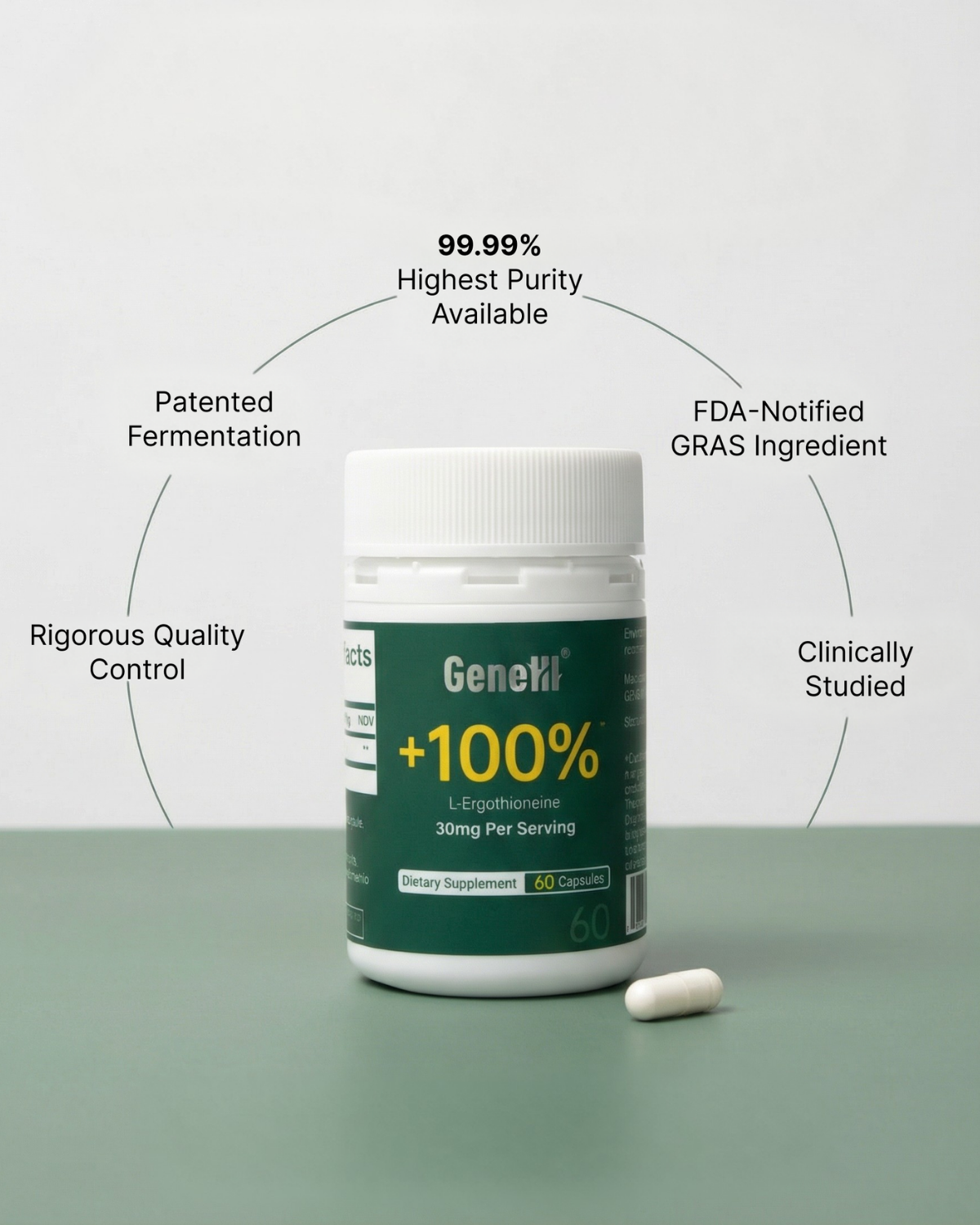
Expert tip: Under GRN 001270, the FDA issued a “No Questions” response to GeneIII’s GRAS notice based on the information submitted. This response should not be interpreted as FDA approval or independent validation of the manufacturing process or platform. For consumers, the record can be looked up in the FDA’s public database under notification number GRN 001270.
What This Means for Your Choice
Purity and dosage are the figures most people look at when choosing an L-ergothioneine, and what determines those figures is the production route behind them.
GeneIII chose whole-cell fermentation to give the product a cleaner, more trustworthy starting point from the source. You can explore GeneIII's L-ergothioneine capsules to see how this process translates into the finished product.
Common Questions About GeneIII's Fermentation Process
Q1: How does GeneIII make its L-ergothioneine?
GeneIII uses whole-cell fermentation. The molecule is produced naturally inside living cells, which follow their own metabolic pathway, and is then purified from the fermentation broth.
Q2: What is whole-cell fermentation, in simple terms?
The cell works like a complete "green factory." With the synthesis genes added, the bacteria build L-ergothioneine inside their own cells, rather than having it assembled in an external reactor.
Q3: How is this different from chemical-enzymatic methods?
Chemical-enzymatic routes first prepare an intermediate through chemical reactions, a step that uses reagents such as methyl iodide. GeneIII's route skips that, letting the cell's own metabolism do the work.
Q4: Does the production route affect purity?
Yes. The route sets the baseline, and downstream purification and quality control finish the job. Fewer external chemicals introduced along the way means a cleaner starting point.
Q5: How pure is GeneIII L-ergothioneine?
It reaches 99.99% purity, confirmed by third-party testing from SGS (report No. ASH25-0074172-04), and is produced under cGMP pharmaceutical-grade manufacturing for batch-to-batch consistency.
Q6: Is GeneIII L-ergothioneine backed by an FDA filing?
Yes. GeneIII L-Ergothioneine received an FDA "No Questions" Letter for its GRAS notification (GRN 001270) in January 2026, which covers notified use levels up to 150 mg per 100 g for protein and nutritional powders.
References
Frost & Sullivan and GeneIII (2026). Global Ergothioneine Industry Current Landscape and Development Trends White Paper.
Shanghai Institute of Organic Chemistry, CAS. A Chemical-Enzyme Coupling Method for the Synthesis of Ergothioneine, patent CN 116855467 A.
U.S. Food and Drug Administration. GRAS Notice No. GRN 001270, Gene III Biotechnology Co., Ltd.


